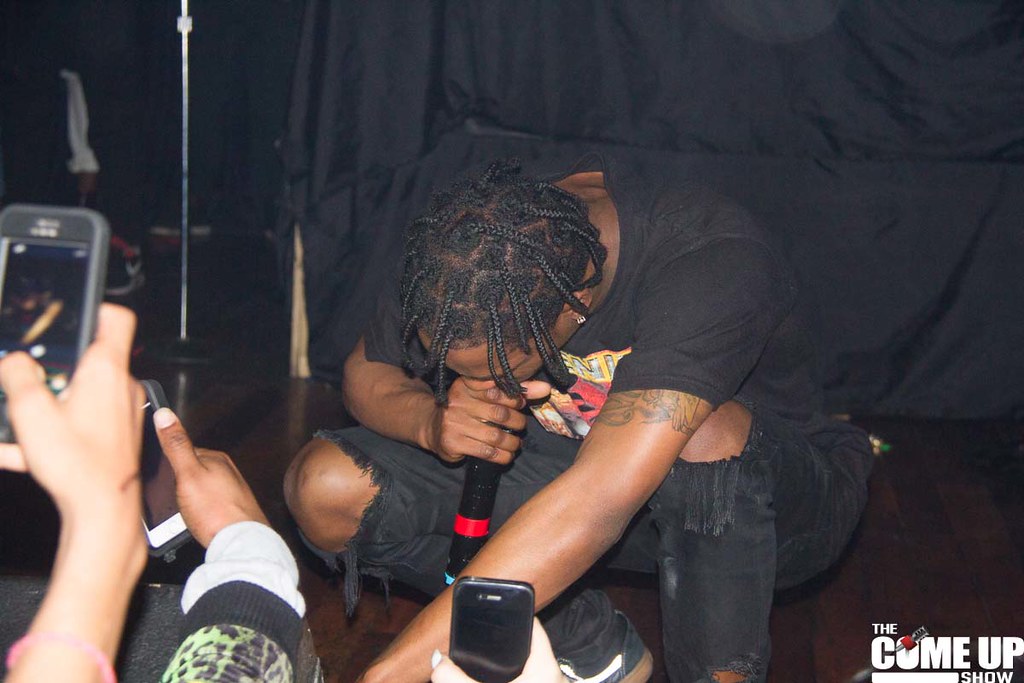
Travis Scott, Killer Mike, T.I. and others are before the US Supreme Court arguing that rap music is being used as a lethal weapon by the state. Here is why this matters far beyond one case.
In 2026, a man in Texas is facing execution. He was convicted of two murders in 2009; crimes he confessed to on television with his own words. There is no dispute about the facts of what happened. What is in dispute is what happened next; at the sentencing phase of his trial, the prosecution introduced over forty pages of his handwritten rap lyrics to argue that he was likely to be dangerous in the future. A predominantly white jury reviewed those lyrics twice during deliberations. They sentenced him to death.
The case of James Garfield Broadnax is now before the Supreme Court of the United States. Alongside his legal team, a coalition of musicians; Travis Scott, Killer Mike, T.I., Young Thug, and Fat Joe; has filed briefs arguing that what was done in that courtroom was unconstitutional. That rap music was put on trial alongside the man who wrote it. And that this is not an isolated incident.
This is both a story about the law and a story about music. CKDS Radio covers both.
What Happened in Garland, Texas
In the early hours of June 19, 2008, Stephen Swan and Matthew Butler were found shot dead outside a recording studio in Garland, Texas. James Broadnax, then nineteen years old, and his cousin Demarius Cummings had travelled to the studio intending to commit a robbery. Both men died at the scene.
Broadnax’s apprehension came partly through his own actions. He returned to a relative’s apartment in Dallas and told family members he had “hit a lick”; a term for robbery; and showed them the identification of one of the victims. When family members recognised the crime from local news coverage, they contacted police. Broadnax and Cummings were stopped in Texarkana, some 150 miles from Garland, driving the victim’s car.
What followed was a series of televised police interviews in which Broadnax confessed to the killings in specific detail, stated that he alone was responsible, expressed no remorse, and said he wanted to receive the death penalty. These interviews formed the backbone of the prosecution’s case at trial.
The defence did not contest the killings. Their strategy focused on mitigation; Broadnax’s youth, his incomplete brain development at nineteen, and testimony that he had been under the influence of marijuana and PCP at the time of the offence and during the confessions. Expert testimony from a jail physician described hallucinations and perceptual disturbances. Prosecutors countered with reporters and officers who described Broadnax as rational and lucid throughout.
During later federal habeas proceedings, Broadnax’s legal team discovered a spreadsheet used by the Dallas County District Attorney’s Office during jury selection. The document recorded the race and gender of prospective jurors and, critically, bolded the names of every Black prospective juror. This is almost identical to the evidence that led the Supreme Court to rule in Foster v. Chatman (2016) that a Georgia prosecutor had deliberately excluded Black jurors.
The federal courts refused to consider the spreadsheet. Under the strict evidentiary rules of the Antiterrorism and Effective Death Penalty Act (AEDPA) and the Supreme Court’s ruling in Cullen v. Pinholster (2011), federal habeas review is limited to the record that was before the state court at the time of its decision. Because the spreadsheet was discovered after the state appeals process had concluded, it could not be used; regardless of what it showed.
Forty Pages of Rap Lyrics; and a Death Sentence
This is where the music enters the story. Texas capital cases require the jury to answer a specific question; is there a probability that the defendant would commit criminal acts of violence that would constitute a continuing threat to society? This is the “future dangerousness” standard, and it requires not just a judgement about what someone did, but a prediction about who they will be.
To meet this burden, the prosecution introduced over forty pages of Broadnax’s handwritten rap lyrics at the sentencing phase. These lyrics were not used during the guilt phase; his confessions had already established his guilt. They were introduced solely to portray his character; to argue that a man who wrote rap music about violence was, by nature, a person likely to commit future violence.
The jury, eleven of whom were white and largely unfamiliar with hip-hop as an art form, asked to review the forty pages of lyrics not once but twice during deliberations. They sentenced Broadnax to death. His execution is scheduled for April 30, 2026.
The jury asked to review forty pages of rap lyrics twice during deliberations. They sentenced him to death.
Travis Scott, Killer Mike, and the Case Before the Supreme Court
The 2026 Supreme Court petition is supported by amicus briefs from some of the most prominent figures in hip-hop. Travis Scott’s brief, prepared by attorney Alex Spiro, argues that penalising a defendant for their artistic expression constitutes an unconstitutional content-based penalty. Rap music, like any other fictional medium, uses storytelling, hyperbole, and performance conventions that are not intended to be read literally. By treating these conventions as evidence of criminal propensity, the state is effectively putting the genre itself on trial.
“No matter how horrific art may sound, it remains an interpretation of the human spirit and not a literal admission of guilt.” Killer Mike
Killer Mike’s coalition focuses on the Fourteenth Amendment’s Equal Protection Clause. Their brief points to research by Professor Erik Nielson, a leading academic authority on hip-hop, demonstrating that the same lyrics are perceived as significantly more threatening when identified as rap rather than as country music. Studies show that jurors are substantially more likely to believe a young Black man is capable of murder after reading violent rap lyrics attributed to him; a finding that suggests rap evidence functions as a racial proxy, allowing prosecutors to appeal to anti-Black stereotypes without making explicit racial arguments.
The Eighth Amendment argument completes the picture. If a death sentence rests in part on fictional artistic expression rather than verifiable facts; and if the prosecution itself chose not to use those lyrics during the guilt phase because they were not relevant to the crime; then their use during sentencing to brand a defendant as a “gangster” is, the coalition argues, an insufficient and unconstitutional basis for execution.
The Broader Pattern; Hip-Hop in the Courtroom
The Broadnax case is not an anomaly. The use of rap lyrics as criminal evidence has become a documented pattern in American courtrooms. Young Thug faced a similar situation in the YSL RICO case in Georgia, where his lyrics were introduced as evidence of gang membership and criminal intent. The “Protect Black Art” movement that emerged from that case has become a coordinated legal and cultural campaign, of which the Broadnax petition is the most significant test to date.
In 2024, the Texas Court of Criminal Appeals itself recognised the problem. In Hart v. State, the court reversed a capital murder conviction because rap videos and social media posts had been improperly admitted as evidence, concluding that their prejudicial effect substantially outweighed their probative value. The court noted that music has a unique emotional impact on juries and that rap lyrics are frequently fictitious or exaggerated.
Broadnax’s attorneys argue that if Texas’s own highest criminal court has acknowledged the inherent prejudice of rap evidence in the guilt phase, the same reasoning must apply at the sentencing phase; where the question is not what someone did but who they are and what they might do next.
The Double Standard; Genre, Race, and the Law
One of the most powerful arguments in the amicus briefs concerns what is not happening in other courtrooms. Violent imagery is a feature of many musical genres. Country music has songs about murder, revenge, and crime. Heavy metal has built an entire aesthetic on themes of death and destruction. Classic rock is full of rebellion and transgression. These lyrics are not introduced in criminal trials to prove that country singers or heavy metal musicians have a propensity for future violence.
Rap lyrics are. Consistently, disproportionately, and almost exclusively when the defendant is Black.
The Fried study of 1999, and its 2016 replication, demonstrated that participants rate the same lyrics as more threatening and more deserving of restriction when they are told the lyrics are rap rather than country. The racial dimension of that finding is not incidental; it is the point. The amicus briefs argue that admitting rap lyrics in trials like Broadnax’s allows the prosecution to benefit from pre-existing racial anxiety without ever having to articulate it.
The same lyrics are rated as significantly more threatening when identified as rap rather than as country music. The research is clear. The implication is uncomfortable.
What Happens Next
If the Supreme Court grants review, it will be the first time the court has directly addressed whether rap lyrics can be used as propensity evidence in capital sentencing. A ruling in Broadnax’s favour could establish that such evidence is presumptively inadmissible; requiring prosecutors to demonstrate a direct connection between specific lyrics and specific facts of the crime before they can be introduced.
The state of Texas maintains that the case is procedurally barred and that the lyrics were a legitimate reflection of Broadnax’s mindset. They argue that his own detailed televised confessions were more than sufficient to justify the sentence, independent of any lyrics.
Both of those things may be true simultaneously. A person can be guilty of a terrible crime and still be sentenced through a constitutionally flawed process. The question before the Supreme Court is not whether James Broadnax committed these murders; he has never denied it. The question is whether his handwritten rap lyrics should have been placed before a predominantly white jury and treated as a window into his future soul.
Why This Matters Beyond One Case
Hip-hop is the most commercially dominant musical form in the world. It has produced some of the most significant art, social commentary, and cultural expression of the last fifty years. It is also a genre that has been disproportionately subjected to surveillance, criminalisation, and legal scrutiny in ways that other genres are not.
When Travis Scott’s legal team says that “the entire genre of rap music” is on trial, they are not being hyperbolic. Every aspiring rapper who writes violent lyrics as a professional convention; which is to say, most aspiring rappers; could theoretically have those lyrics used against them in a courtroom. Not as evidence of what they did, but as evidence of who they are.
That is a profound and chilling proposition. And it is why the coalition of artists before the Supreme Court in 2026 is not arguing for James Broadnax alone. They are arguing for the proposition that art is art; that fiction is fiction; and that the state should not be permitted to execute a man, in part, because of the genre he chose to write in.
The execution date is April 30, 2026. The Supreme Court has not yet indicated whether it will hear the case.
CKDS Radio | Music, Culture and Justice | March 2026